Designing a More Connected Care Experience for Older Adults
Independent Service Design Exploration · Healthcare Operations · Systems Thinking
Overview
For older adults managing multiple health conditions, preparing for specialist appointments can involve coordinating services beyond the clinical visit itself.
Drawing on a firsthand caregiving experience, I explored the challenges of arranging recurring in-home lab work across multiple healthcare providers. Through service design methods, I examined the patient and caregiver journey to identify opportunities for clearer coordination, more predictable handoffs, and reduced administrative burden.
Project at a Glance
Role: Independent Service Design Exploration
Focus: Patient and caregiver experience, lab coordination, and continuity of care
Methods: Journey mapping, stakeholder ecosystem mapping, current-state analysis, and future-state concept development
Scope: Firsthand observations of the patient-facing experience and caregiver coordination. Internal provider workflows were identified as areas for further investigation.
The Challenge
An older adult I supported receives ongoing care from multiple providers, including cardiology, endocrinology, and primary care. Specialist appointments typically occur every three to four months and require lab work beforehand. Appointments sometimes fall within the same week or even on the same day.
Due to age and mobility considerations, in-home blood draws are preferred. Although this is an established part of the senior's care routine, arranging the service continues to require active coordination from the patient or caregiver.
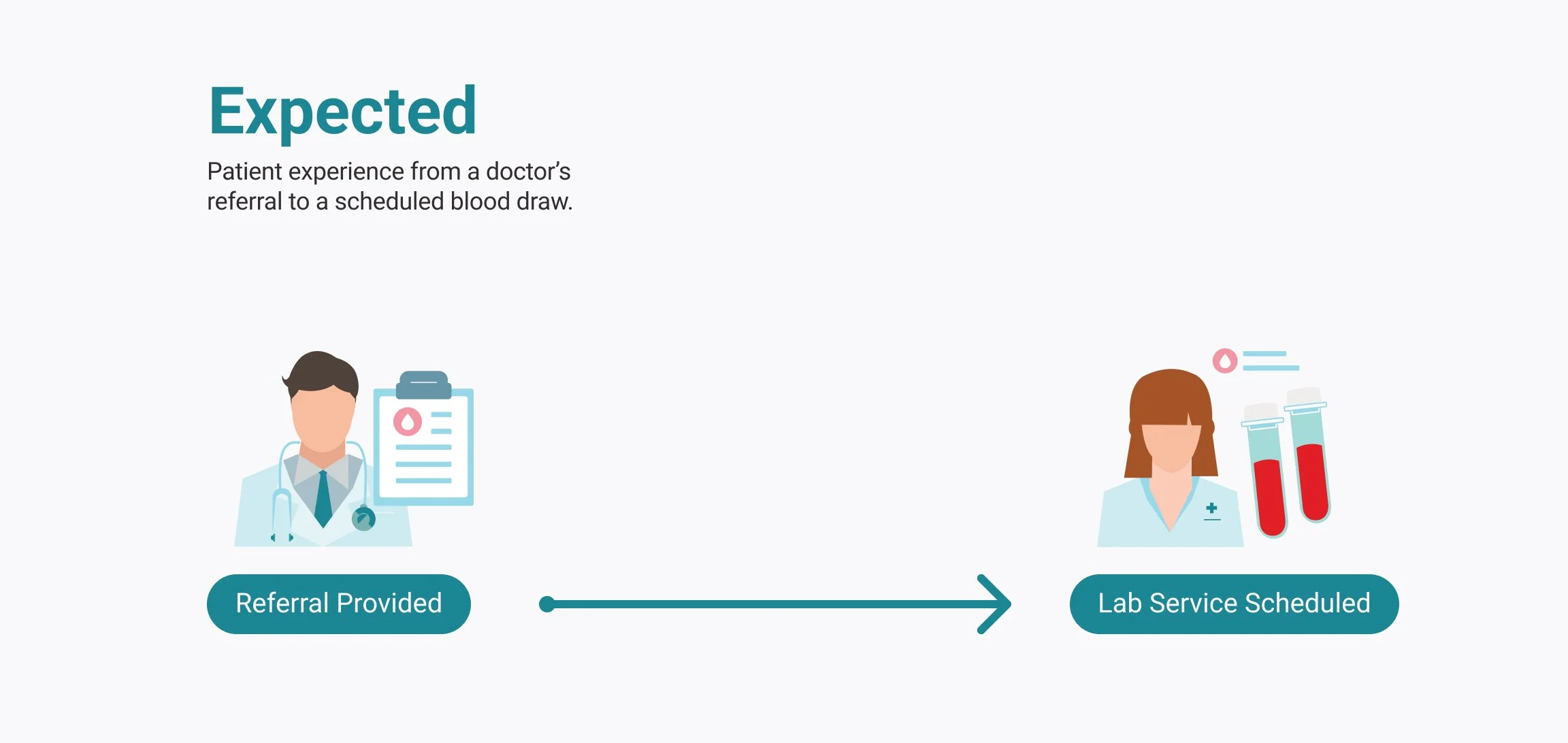
Approximately two weeks before a specialist follow-up, the patient or caregiver needs to contact the specialist's office to prompt the lab order to be sent to the external laboratory service. They must then follow up with the lab service to confirm receipt and arrange the in-home visit. If the order has not arrived, additional follow-up is needed before scheduling can proceed.
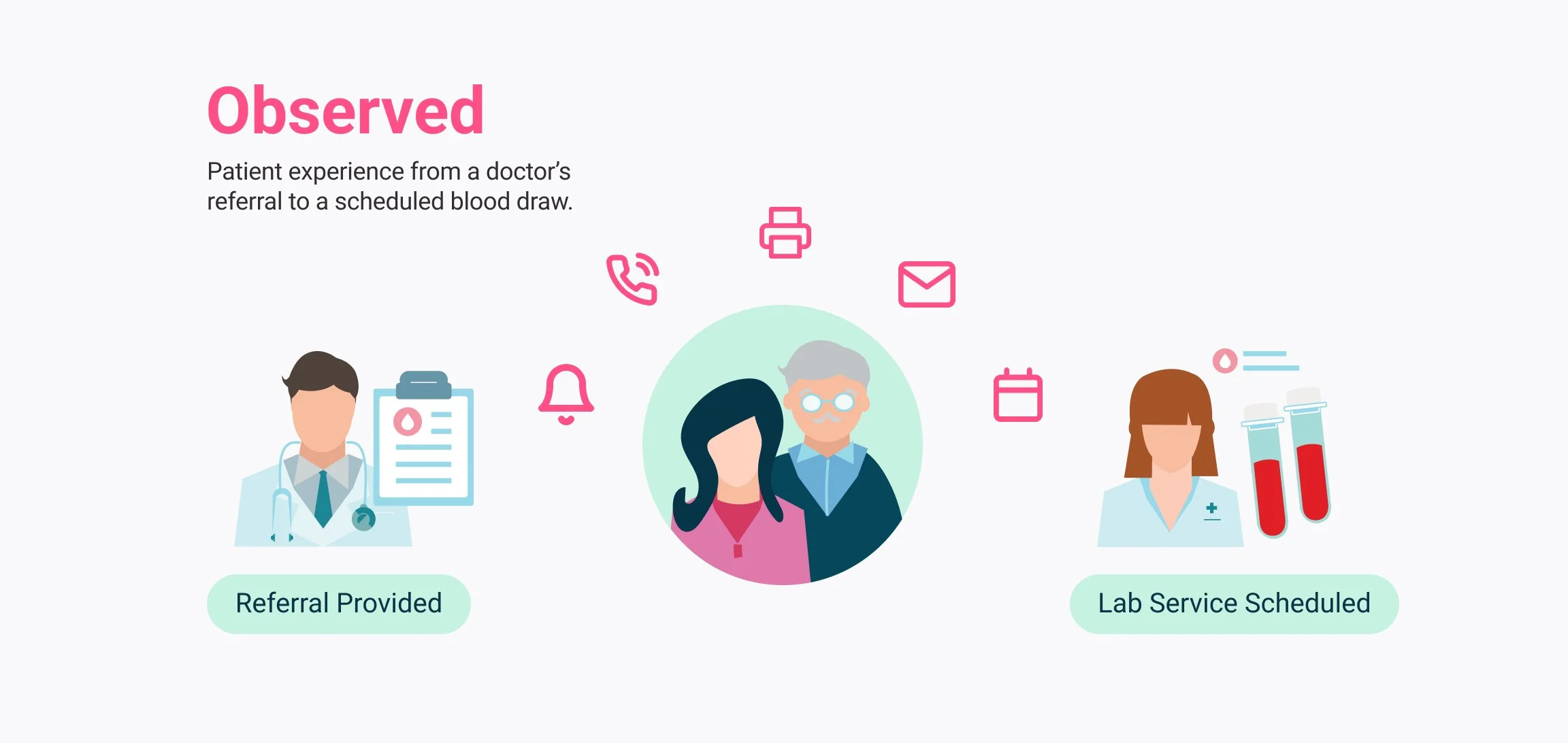
The process relies on the patient or caregiver to track upcoming appointments, initiate communication, verify that the necessary information has been received, and ensure there is enough time for testing before the specialist visit.
The underlying challenge: A recurring clinical requirement creates repeated coordination work when the steps between separate healthcare services are not sufficiently predictable from the patient and caregiver perspective.
Design question: How might we make recurring in-home lab work easier to coordinate, so required tests are completed in time for specialist follow-up appointments?
Understanding the Current Experience
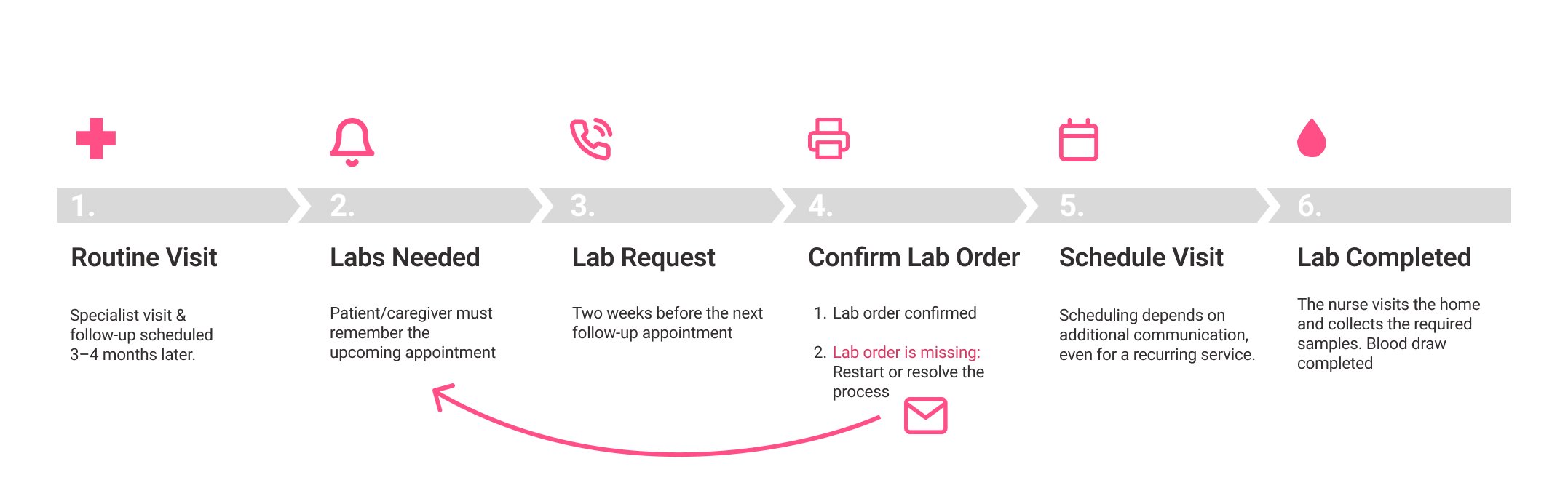
I mapped one observed blood-draw journey, from the specialist visit and identification of lab requirements through order follow-up, scheduling, and completion of the in-home service.
The journey revealed that completing a routine clinical requirement depended on several actions outside the clinical appointment itself. The patient or caregiver needed to remember when to initiate the process, contact the relevant offices, verify that the lab order had arrived, and coordinate a suitable appointment time.
A key point of friction emerged when the laboratory service had not received the order. Rather than progressing directly to scheduling, the process required additional communication to resolve the missing information.
This created a need to begin coordination well ahead of the specialist follow-up, allowing time to address potential delays and complete testing.
This shifted my focus from the individual task to the connections between services: how referrals are communicated, how responsibilities are understood, and how patients know what happens next.
Key Questions Along the Journey
Has the lab order reached the appropriate service?
Is any additional information or action required?
What needs to happen next, and who needs to initiate it?
When can the in-home visit be scheduled?
Will the required testing be completed in time for the specialist follow-up?
These questions reflect the patient and caregiver perspective. They identify points of uncertainty without assuming how the organizations' internal processes operate.
(current-state journey map below)
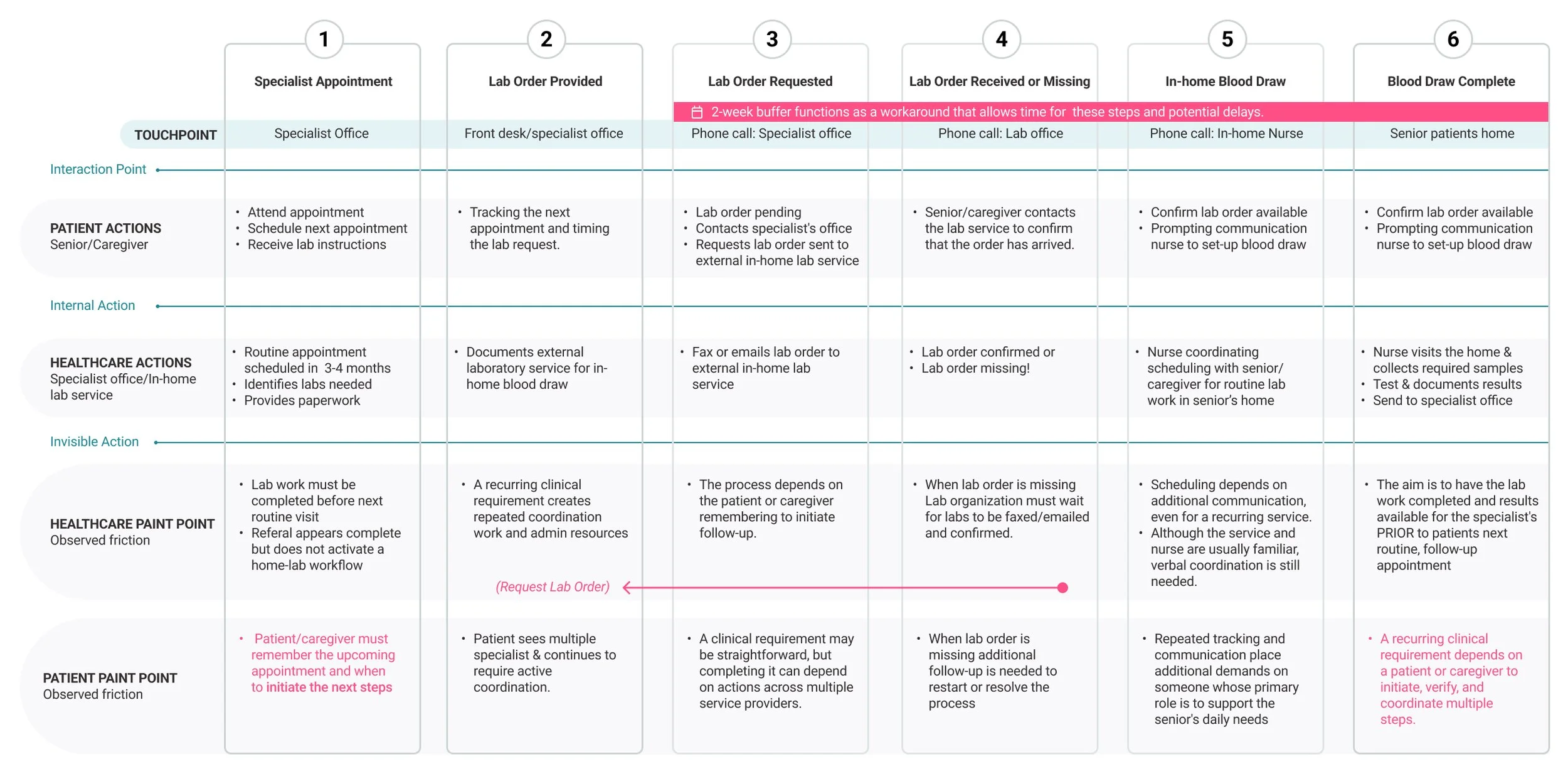
One observed patient and caregiver journey, mapping actions, communication touch-points, follow-up requirements, and points where the process may stall.
Key Insight
The Caregiver becomes the coordinator
The caregiver's role extended beyond providing personal support. It also involved tracking upcoming lab requirements, prompting communication between organizations, confirming receipt of orders, and coordinating scheduling.
This revealed three service design considerations.
Coordination is part of the care experience
A clinical requirement may be straightforward, but completing it can depend on actions across multiple service providers.
Handoffs can introduce uncertainty
When an order has not reached the laboratory service, the patient or caregiver may need to initiate additional follow-up to move the process forward.
Administrative work competes with caregiving
Repeated tracking and communication place additional demands on someone whose primary role is to support the senior's daily needs.
This exploration reflects one firsthand caregiving experience. The observations identify opportunities for further investigation rather than establishing that the same challenges occur across all older adults or healthcare settings.
Mapping the Service Ecosystem
The journey map shows what the patient and caregiver experience. An ecosystem map provides a broader view of the people and organizations involved in that experience.
The relevant stakeholders include:
The senior receiving care
The caregiver
The specialist's office
The primary care provider, where relevant
The external in-home laboratory service
Scheduling and administrative staff involved in coordinating care
These stakeholders contribute to different parts of the journey, but their respective responsibilities, information needs, and internal workflows have not been independently verified.
The ecosystem map therefore distinguishes known patient-facing relationships from areas requiring further research. It provides a starting point for investigating how orders, scheduling information, and responsibility for follow-up move between organizations.
(stakeholder ecosystem map below0
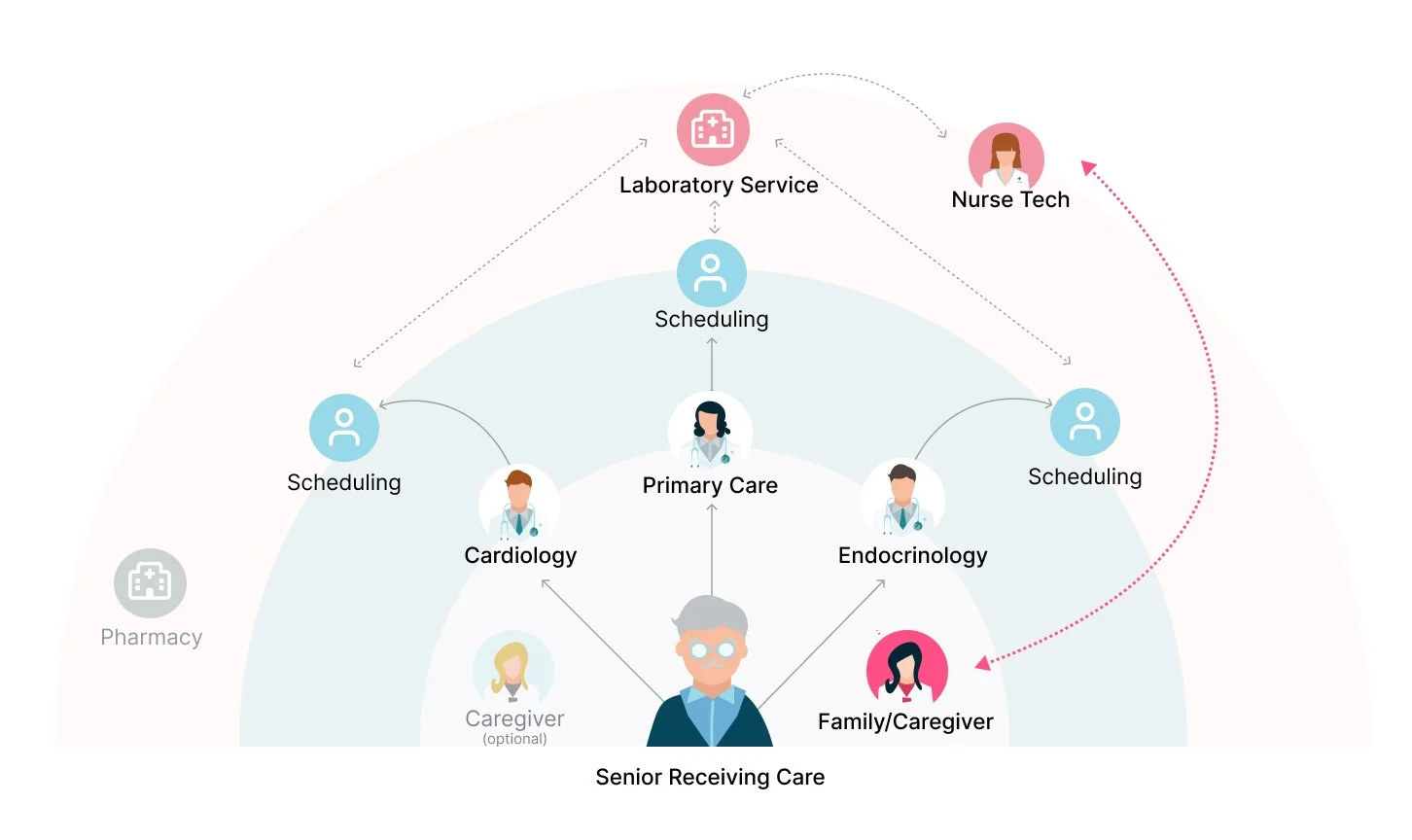
A preliminary ecosystem map identifying known patient-facing touchpoints and relevant stakeholders for further investigation.
Envisioning a More Connected Future State
The current experience depends on the patient or caregiver coordinating individual lab requests. A more connected service could instead organize testing around the senior's overall care schedule.
Because specialist appointments sometimes cluster within the same week, there may be an opportunity to coordinate compatible lab requirements across providers rather than arrange each request independently.
Coordinate Testing Around Upcoming Appointments
Explore how upcoming specialist appointments and required tests could be reviewed together. Where clinically appropriate, compatible blood and urine tests could be consolidated into a single in-home visit.
This would require confirmation of each provider's orders, the required tests and specimens, and the appropriate timing for collection.
Reduce the Caregiver's Coordination Burden
Explore a process that provides clearer confirmation of order receipt, scheduling, and outstanding actions. Rather than maintaining a separate tracking system and repeatedly contacting different offices, the caregiver could receive more predictable updates about what has been arranged and what remains to be done.
The goal is to reduce the caregiver's role as the connection between services, allowing more time to focus on the senior's daily care and well-being.
Proposed Future-State Workflow
Upcoming specialist appointments identified → Lab requirements and orders coordinated → Compatible tests consolidated where feasible → In-home visit scheduled → Testing completed and results routed to the appropriate providers
(conceptual future-state workflow below)
Caption: A proposed service concept for coordinating recurring lab requirements around upcoming specialist appointments. This is a hypothesis for further exploration, not a representation of an existing healthcare workflow.
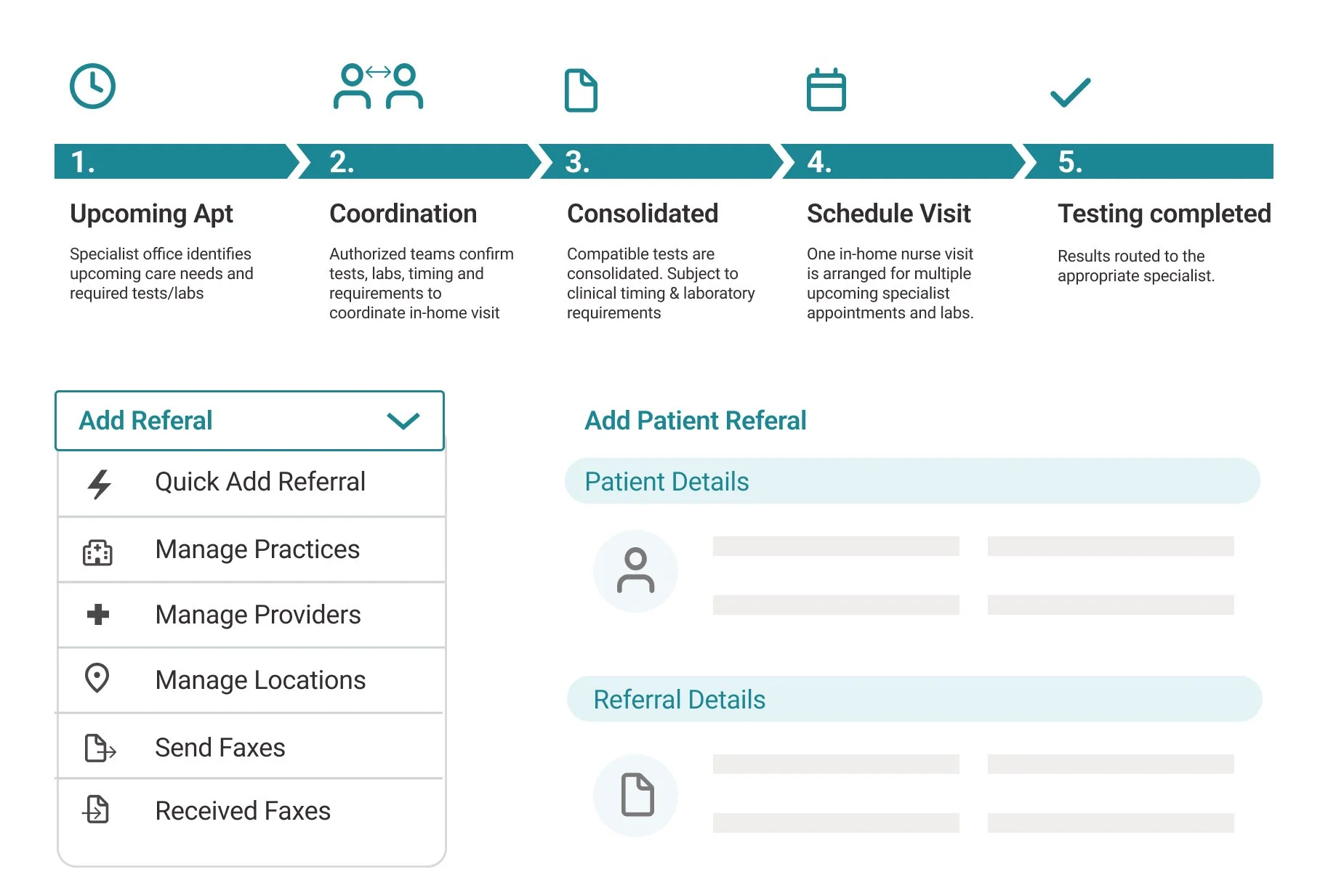
A proposed service concept for coordinating recurring lab requirements around upcoming specialist appointments. This is a hypothesis for further exploration, not a representation of an existing healthcare workflow.
Potential Benefits
Fewer disruptions: Reduce separate in-home visits where compatible testing can be consolidated.
More predictable coordination: Improve confirmation of orders, scheduling, and next steps.
Reduced administrative burden: Minimize repeated manual tracking and follow-up by patients and caregivers.
Support for continuity of care: Help ensure required testing is completed and results reach the appropriate providers before follow-up appointments.
These benefits are intended outcomes, not measured results.
Opportunities for Service Improvement
The exploration suggests three areas to investigate with patients, caregivers, and healthcare staff.
Clarify responsibility for follow-up. Understand who currently monitors outstanding orders, resolves missing information, and communicates next steps and where responsibility could be made clearer.
Improve visibility across service handoffs. Explore whether authorized staff can confirm order receipt and identify outstanding actions without relying on repeated manual follow-up.
Coordinate recurring testing where feasible. Investigate whether lab requirements across multiple specialists can be aligned to reduce unnecessary visits while respecting clinical timing, specimen requirements, and laboratory capabilities.
Any proposed changes would need to account for privacy, consent, clinical responsibilities, system capabilities, and the operational requirements of participating organizations.
How Success Could Be Measured
The future-state concept would need to be validated before its effectiveness could be assessed. Potential measures include:
Time from lab order initiation to confirmed scheduling
Percentage of orders requiring additional follow-up
Frequency of missing or incomplete orders
Percentage of required lab work completed before specialist follow-up
Number of separate in-home visits required for compatible testing
Patient and caregiver understanding of next steps
Time spent by patients and caregivers on coordination-related tasks
These are proposed evaluation measures, not results from a tested intervention.
Reflection and Next Steps
This exploration shifted my perspective from viewing healthcare as a series of individual interactions to examining the connections between services.
By tracing the patient and caregiver journey, I identified how repeated follow-up, uncertainty around order receipt, and manual scheduling can create additional coordination work around an otherwise routine clinical requirement.
The project also reinforced the importance of distinguishing firsthand observations from assumptions about internal operations. Understanding the full service would require further research with the people responsible for referrals, scheduling, laboratory services, and care coordination.
The proposed future state offers an opportunity to explore how recurring lab requirements might be coordinated around the senior's overall care schedule, reducing avoidable disruptions and administrative demands on caregivers.
My background in digital product design, combined with firsthand caregiving experience, informs how I approach complex problems: understanding people's needs, mapping interconnected processes, identifying friction points, and translating observations into opportunities for service improvement.
The next phase would be to validate the findings with stakeholders, investigate operational feasibility, and determine which changes could make the experience more connected, predictable, and easier to navigate.
UX Overhaul for SimpleEvents
A B2B and B2C event platform streamlined workflows, reducing friction by 40% and improving task completion by 30%, boosting user satisfaction and empowering teams.