


Smarter Venue Sourcing. Stronger Leads.
Impact / Business Outcomes
Generate leads: Streamlined venue sourcing acts as a lead generation engine for SimpleEvents.
Reduce workload: Optimized venue data and eliminated manual input for event planners.
Inspire collaboration: Curated, premium venue options enhance client engagement and planning efficiency.

Problem
Finding venues for global events—conferences, retreats, and incentive trips—was time-consuming and fragmented for SimpleScience planners. How might we leverage existing partnerships and venue data to simplify sourcing, reduce manual effort, and improve client collaboration?
Solution / Approach
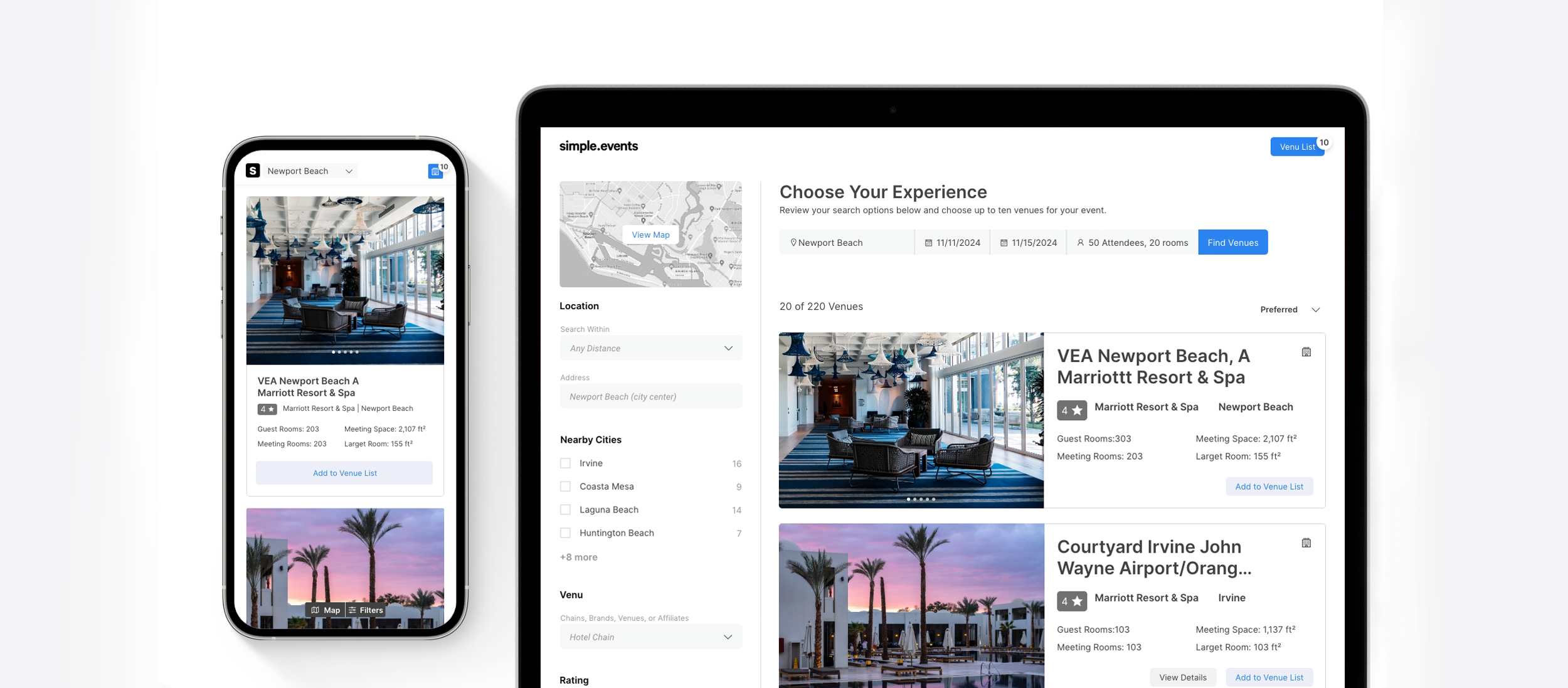
We designed and launched a standalone venue-sourcing web application that connected planners and venues efficiently while driving new leads for SimpleEvents.
Streamline venue discovery and match event requirements to available spaces.
Eliminate repetitive manual data entry.
Inspire collaboration between event planners, clients, and venues.
Provide visually engaging venue options to attract new clients.

Results & Lead Generation Impact
Reduced manual workload for planners, allowing focus on high-impact tasks.
Data collection became a core lead-generation engine for SimpleEvents.
Improved client experience by showcasing curated venues with high-quality images and detailed information.
Created opportunities for evolving the SimpleEvents platform over time, informed by real-world usage and feedback.
User Research & Insights
The platform’s primary users included both event planners and premium clients. The research focused on uncovering inefficiencies in venue sourcing and identifying opportunities to streamline workflows through a digital platform.
Research Methods
• Competitive review: Reviewed leading platforms to uncover UX best practices and feature gaps.
• Workflow mapping: Documented planner processes to pinpoint time sinks, redundancies, and manual steps.
• Empathy-led interviews: Collaborated with SimpleScience planners and clients to understand daily challenges, communication patterns, and trust-building needs.
Flow Diagram Before:
Planners → Spreadsheets → Emails → PDFs → Manual Updates
-
Key Insight:
After interviewing planners and reviewing their spreadsheets and venue PDFs, it became clear that the sourcing process relied heavily on manual data management and fragmented communication. Optimizing this workflow was essential to improve speed and collaboration.
Pain Points
• Sourcing venues for events—from 20-person executive meetings to 3,000-person conferences—was time-consuming and repetitive.
• The back-and-forth with suppliers delayed quotes and made it difficult to compare options.
• Event details were managed across multiple touchpoints, increasing error risk.
• Key data like capacity, pricing, and amenities weren’t easily visible at a glance.
• Custom recommendations were limited, and budget transparency was low.
• Average supplier response time ranged from 2–5 business days, reducing competitiveness. -
Current State
Before the Sourcing Platform, planners relied on a shared database of trusted venues, manually logged in spreadsheets. Updates, images, and client details were handled individually, creating inefficiencies and data inconsistencies.Information Sharing
Venues typically provided event details in static PDF files. Once a venue was chosen, communication continued via emails and phone calls—difficult to track, inconsistent, and siloed across teams.External Tools
Travel platforms like Kayak, Travelocity, and Orbitz offered inspiration but lacked the data required for large-scale corporate events—such as detailed capacity, layout, and availability—highlighting the gap that SimpleEvents could fill.
Design Decisions & Features
Comprehensive search: Over 300K global venues, filterable by occupancy, ratings, and amenities.
Budget & attendance tools: Quickly estimate costs and capacity.
Comparison & sharing: Enable planners to compare venues and share selections with clients.
Visual inspiration: Large photos and detailed descriptions to guide decision-making.
-
The new sourcing platform brings all your venue data, and tracking into one platform that everyone can use at scale.
• Easily find preferred suppliers and venues with key data sets your company values.
• Automatically receive quotes for all your event needs and always choose the best venue for your event.
• Recieve tailored event experiences with experts who care.Get the most from your RFPs and Eliminate the back and forth by building RFPs with details that mean the most to you so venues can respond with a customized proposal.
• Customize your RFPs to your needs
• Attach and send additional files easily.
• Send one RFP to multiple venues.
• Save and clone criteria for future use. -
Track and manage venue responses on a centralized platform. Compare venues and narrow down results. Shortlist properties quickly.
• Compare bids side-by-side.
• Communicate with venues on key details.
• Share comparisons with stakeholders with easy reporting.
• Save your preferred venues for future events.
• Review and rate venues after the event.


Collaboration & Iteration
Communication with the development team was essential. Beta versions were tested and feedback collected via Pastel, allowing rapid iteration and bug fixes. The launch was a halfway mark: the platform continues to evolve based on usage data and client interactions, highlighting opportunities to enhance the overall product and business experience.
Design → Beta → Feedback → Launch → Iterate
Regular feedback loops ensured alignment between design and development, allowing rapid iteration and improving the product before launch.
-
• A master components file helped define brand guidelines, colors, fonts, etc.
• XD sharable links are used to review and comment on all our digital design files before handing them off to the development team.
• Pastel is the tool of choice to communicate with the dev team. It’s website feedback software that allows designers and developers to collect feedback on websites that are in beta.
• Review from the sourcing team. Feedback and testing were given to the sourcing team.

Conclusion / Reflection
This project demonstrates how UX design can drive tangible business outcomes: streamlining workflows, generating leads, and creating a foundation for evolving a SaaS ecosystem. By designing both for internal efficiency and external growth, the venue-sourcing tool exemplifies integrated, user-centered design with measurable impact.

